Showing posts with label Japanese. Show all posts

Monday, December 31, 2012

Renkon Pickles

Renkon no Sunomono (Marinated Lotus Root)

Makes 6 servings
8-inch piece of renkon (lotus root)
4 tablespoons rice wine vinegar
3 tablespoons granulated sugar
1 tablespoon salt
Finely grated lemon rind, for garnish
1. Wash the renkon thoroughly, then peel off the outer layer with a vegetable peeler, and slice into thin slices. Blanch the slices in a pot of boiling water for 1 minute and then drain.
2. Combine the remaining ingredients then toss with the renkon slices. Chill the renkon in an airtight container overnight.  To serve, garnish with finely grated lemon rind.


http://www.lafujimama.com/2011/12/renkon-no-sunomono/

*They only came out so-so. I will have to play with this recipe some more.

Daikon no Nimono, Boiled Radish

 A massively oversized radish, daikon is a popular Japanese winter root vegetable. Less spicy than Western radishes, daikon features in a lot of seasonal cooking, and boiling brings out its natural sweetness wonderfully. Today’s dish is a simple but deeply satisfying side: basically slow cooked radish with a bit of pork in a classic Japanese sauce.
Wait, pork? In a vegetable side dish? Actually yes, just a bit. Makes everything much tastier.
This is a basic (if under-appreciated) principle of Japanese cooking: almost every dish has some kind of meat or seafood in it, even the vegetable side-dishes. Usually, it’s a very small amount: more to flavor the dish than anything else. On the other hand, very few dishes are centered around a big piece of meat or fish, like they so often are in the West.
In other words, in traditional Japanese cooking we eat food, not too much, mostly plants.

daikonIngredients (for four)
  • Daikon – one full radish
  • Pork – 100 grams
For the sauce
  • Water – four cups
  • Dashi – 1-teaspoon
  • Ginger – a small piece
  • Sugar – 4 tablespoons
  • Sake – 2 tablespoons
  • Salt – 1/2 a teaspoon
  • Soy sauce – 5 tablespoons
  • Mirin – 3 tablespoons
Preparation
  • Take one whole daikon and slice it into 8-10 cm. long segments. Peel each segment
  • Peel the ginger and slice it thinly
  • Slice the pork into small pieces
cut daikon peel daikon daikon ready
pork and ginger click to enlarge

Cooking
  1. Put the daikon pieces in a large pot and add just enough cold water to cover it. Set the pot on a high flame until it boils
  2. Allow the daikon to boil for 30 minutes until they offer a chopstick very little resistence when you poke them
  3. Drain the hot water, cool the daikon with cold water, then take them out of the pot
  4. Wash the pot with soap and water, rinse
  5. Return daikon to the pot and add the ingredients for sauce (four cups of water, ginger slices, pork, dashi, mirin, sake, sugar, salt and soy sauce)
  6. Bring everything to a boil over a medium flame
  7. Cook, covered, over a medium-low flame, for fifteen minutes. Every five minutes or so, uncover the pot, skim off the yucky scum that rises to the top as it cooks with a slotted spoon, then cover again
  8. Here comes the trick: cover the simmering daikon with two layers of paper kitchen towels, making a little dome. This allows the daikon to absorb the sauce better.
  9. Keep cooking under paper towels like this for another 40-45 minutes.
  10. When serving, do not add the ginger slices onto the plate – those are just for flavoring
boil daikon wash daikon Bring everything to a boil again over a medium flame
skim off the yucky scum cover the simmering dish with paper kitchen towels click to enlarge
For best results, you want to turn off the heat, let it cool, and then reheat a few hours later. So think about making this at lunch time to eat at dinner.

http://kanakoskitchen.com/2009/10/18/daikon-no-nimono-cooked-japanese-radish/

Kuri Kinton


Kuri Kinton (Candied Chestnut & Japanese Sweet Potato Mash)

Recipe as shared by my friend Noriko
Makes 6 to 8 servings
1 pound satsumaimo (Japanese sweet potatoes)
7 ounce bottle of kuri kanroni (candied chestnuts in syrup)
pinch of salt
mirin
sugar
1. Peel the sweet potatoes then cut them into one-inch slices and soak them in a large bowl of water for 6 to 7 hours.
2. Boil the sweet potatoes until very tender. Mash them with a fork and then push the mashed sweet potato through a sieve to remove any lumps or fiber.
3. Put the mashed sweet potato into a small pot. Add the syrup from the bottle of candied chestnuts, along with a pinch of salt, and cook the mixture over low heat. Add mirin and sugar in equal amounts if the mixture looks too dry. The kuri kinton will stiffen slightly once cooled, so be sure to take this into account when decided how much liquid to add.
4. Continue cooking over low heat, stirring to make sure the mixture doesn’t burn, until it has a slightly glossy look to it. Add the candied chestnuts and cook for several more minutes to heat through and then let cool.

http://www.lafujimama.com/2011/12/kuri-kinton/

Tuesday, October 16, 2012

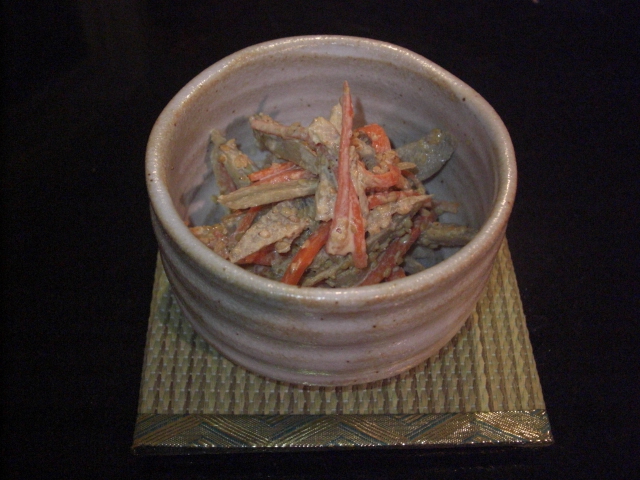
Gobo Salad (mayo)

http://www.japanfoodaddict.com/vegetables/gobo-salad/

Gobo is known as burdock root in English. It is a fibrous vegetable seldom used in North America and Australia, but you can find it at most Asian groceries. This salad is popular way to eat gobo. Many izakaya restaurants serve this salad as an appetizer in Japan and you can also buy it at supermarkets or delis. 
Yield: 2 people
Time: 15 minutes
Ingredients
  • 1/4 lb gobo
  • 1/2 carrot (1/5lb)
Spices
  • 3 tbsp Japanese mayonnaise, such as Kewpie
  • 2 tbsp ground white sesame
  • 1 tsp vinegar
  • 2 tsp soy sauce
  • 1 tsp sugar
Preparation
  1. Wash gobo with water and remove the skin with a carrot peeler or the edge of a knife. Repeat with carrot.
  2. Shred gobo and carrot into thin strips.
  3. Put the gobo in a sauce pan with enough water to cover the gobo. Bring to a boil.
  4. When it is boiling, keep it on for one minutes.
  5. Then add carrot and boil for another minute.
  6. Strain gobo and carrot then cool.
  7. Mix all spices in a small bowl (mayonnaise, sesame, vinegar, soy sauce and sugar.
  8. Mix gobo and carrot with mixed sauce, and serve.

Tuesday, August 7, 2012

Sushi

Thanks, Daniel!

You need Sushi Rice not long grain rice.

2 Cups Water and 2 Cups Sushi (aka short-grained rice). Put in a medium sized pot and bring to a boil. Cover and turn down the heat to low and let simmer for 20 minutes (till all the liquid is absorbed). Turn off the heat and let sit covered till you are ready to do the next part.
While the rice is cooking,
combine in a bowl (for the microwave) or a small pot on the stove.
1/4 Cup Rice vinegar
1 Tablespoon of sugar
2 teaspoons of salt
The point here is to dissolve the sugar and salt, so just heat it and stir it till that happens...just a couple of minutes.

Pour the rice from the pot into a wooden or ceramic bowl and stir it with a lifting motion. Adding a little of the vinegar mixture at a time. You want to combine it into the rice and cool it  which makes it glossy.  If you can use a fan in one hand while stirring  or recruit a  friend  or  have an  electric fan  that helps.  If the rice gets sticky on the  spoon/spatula  rinse it in cold water like you do to the sushi  knife  to  "de-goo-ify"  it.


When it comes to actually rolling the sushi, do the following:
-lay out a sheet of nori.
-Place a large glob of sushi rice onto the nori.
-Use the back side of a spoon (Dipped in water to help keep the rice from sticking) to spread an even layer of rice over most of the sheet of nori. Leave about an inch strip along one edge clear of rice.
-Place a strip of whatever ingrideants you want running parallel to the bare strip of nori, but on the far edge.
-Use your finger to wet the bare strip of nori, and then roll up the nori form the ingrediant side. The wet edge of nori should adhere to the rest of the roll and keep it from unraveling.
-cut to desired thickness.

Egg Vegetable Dish on Rice (Maybe Donburi?)

Basic Ingredients:
-onion
-green vegetable (spinach, kale, cabbage)
-eggs
-oil
-soy sauce
-rice

Other optional Ingredients:
-carrot
-soft potatoes (the red-skin potatoes, or the soft yellow ones I think of as "butter potatoes" but I really don't know what they're really called. NOT the big brown dirty hard baking potatoes.)
-bell pepper, any color
-garlic
-ginger
-mushroom
-zucchini
-bits of tofu would probably be tasty, but I've never tried.

  1. Get the rice cooking.
  2. Cut your onions into small slices (or dice them, depending how you want the texture). Heat a pan with oil, and start the onions cooking on low to medium heat.
  3. While the onions are cooking, chop carrots. Fine rounds, or half moons, or quarters are fine, or dicing them. Again, depends on texture. Put in with carrots, and stir around. Add a few tablespoons of soy sauce (the water on the bottom of the pan will help keep it from burning while you cook other things). Adding a lid helps things cook longer.
  4. If you want to add ginger, mince or grate it and add it now, so the flavors have time to diffuse. Also, if you want garlic, add it now. I have never done both garlic and ginger at the same time, but, who knows, it may be tasty!
  5. Add any medium-hardness vegetables (not hard like carrots or potatoes, but not soft like a leaf. Bell peppers, mushrooms. Now's also a good time to add the stems of the leafy vegetables, or  very small chopped cabbage, if you want).
  6. Crack a few eggs into a bowl and mix with a fork/whisk.
  7. When the onions look clear and the potatoes/carrots are getting soft and edible, put in the soft leafy vegetables. Dark green soft-leaved vegetables, like spinach, bok choy, or komatsuna, can be chopped coarsely.
  8. After you put in the greens, turn the whole mess over a few times with a spoon to get the greens started and make sure everything else is cooked, and then pour eggs over. I whisk while I pour so the eggs drizzle out instead of sliding out with a big plop, and I can cover more of the vegetables more finely.
  9. I turn the mess over once, and then turn the heat off before all the eggs cook-- the heat of the vegetables will cook most of the raw bits of egg. If you are in America and are more worried about salmonela, cook until the eggs are all firm.
  10. Serve over rice! Yum!

Umeboshi

http://www.justhungry.com/homemade-umeboshi-japanese-pickled-plums

Thanks for the link, Ron!

Goya Champloo

Ingredients:

  • 1 goya (bitter gourd)
  • 1 block cotton tofu, drained
  • 1/4 lb thinly sliced pork, cut into bite-size pieces
  • 2 eggs, beaten
  • 2 tsp soy sauce
  • 2 tsp sake
  • salt and pepper
  • vegetable oil for frying

Preparation:

Cut goya in half lengthwise. Remove seeds with a spoon. Slice the goya thinly and place goya slices in a bowl. Sprinkle some salt over them. Let them sit for about 10 minutes. Wash goya slices and drain well. Squeeze them to remove excess water. Heat about 1 Tbsp of vegetable oil in a large skillet. Stir-fry pork and season with salt and pepper. Add goya slices and cook until softened. Crumble tofu into large pieces and add in the skillet. Lightly stir-fry with pork and goya. Season with sake. Pour beaten eggs over and stir quickly. Season with soy sauce. Stop the heat. Adjust the flavor with salt.

Tuesday, May 15, 2012

ビーフねぎ

Cooked with a bit of oil, a bit of soy sauce, and a bit of sugar, thinly sliced beef is suuuuper tastey with fresh green onion.

New discoveries every day!

Saturday, May 12, 2012

Kinpira Gobo (stir fried burdock root)

Something like this:

Ingredients:

  • 1/2 lb gobo (burdock root)
  • 1/4 lb carrot, peeled and cut into short and thin strips
  • 1 1/2 Tbsp mirin (*optional, leave out for alcohol-free)
  • 1 Tbsp sugar (*optional, leave out for sugar-free)
  • 1/2 Tbsp sake (*optional, leave out for alcohol-free)
  • 1 Tbsp soy sauce
  • 1 tsp sesame seeds
  • sprinkling of chili flakes (*optional, leave out for folks who don't handle spicy)
  • 2 tsps vegetable oil (sesame oil for a deeper flavor)

Preparation:

  1. Lightly shave the gobo skin (drag the back of a knife-blade along it rather than a peeler-- most of the flavor is right under the peel). Julienne gobo-- diagonal medallions are a good starting point. 
  2. Soak gobo for 10 minutes, then change water and soak again.
  3. Heat vegetable oil/sesame in a frying pan, and fry gobo for a couple minutes. Add carrot strips in the pan and stir-fry them. Add sake, mirin, and sugar and stir-fry until the liquid is gone. Season with soy sauce and stir-fry well. Turn off the heat. Sprinkle sesame seeds.

Notes:
-dark rings indicate old gobo
-

Friday, February 10, 2012

ちゃはん (Fried Rice)

On medium-high heat, fry in sesame or vegetable oil:
1 onion, chopped
1 carrot, diced
1 cooked potato, cubed
1 cup frozen peas
add a bit of soy sauce or ponzu, and cover to speed up cooking.
When almost done, add ginger and 1/2 cup shredded cabbage, and then day-old rice. Stir.
When done, slowly pour some beaten egg over, trying to spread it as thinly as possible over the entire dish, stir until cooked, and then eat! Great garnished with chopped green onions and kimchee.

Friday, February 3, 2012

Dana's Satsuma Renkon Thang

Satsuma imo sliced in thin, long, rectangular strips (smaller than French Fries, like angel hair pasta, and doesn't need to be peeled), and then fry in sake and soy sauce. Shortly after, put in renkon cut into thin rounds and throw in. Finished when Satsuma imo is orangey yellow.

Will cook most of the sake and soy sauce off, but not all of it because it will buuurn.