Friday, October 19, 2012

Another stab at rice pudding

I used this recipe with already cooked rice (because I left my rice in my cooker accidentally and now it's dry! I hoped cooking over-cooked rice in a liquid will help make it not so tough again, and it worked!).

Super tasty! Though not quite as creamy as I'd like-- the eggs made it have a slightly lumpy texture. (Not the rice kind of lumpy, mind you. That "eggs are congealed and making some sort of little tiny strands of cooked eggy-ness" which is probably a result of how I added the hot milk to my eggs and cooked it too fast.)

So, the main difference is I used rice that's been dried out accidentally, instead of uncooked rice. I greatly reduced the initial cooking time.

link: http://www.simplyrecipes.com/recipes/rice_pudding/

INGREDIENTS

  • 2 1/2 cups (600 ml) of whole milk
  • 1/3 cup (66 grams) of uncooked short grain white rice
  • Pinch of salt
  • 1 egg
  • 1/4 cup (50 grams) dark brown sugar
  • 1 teaspoon of vanilla extract
  • 1/4 teaspoon of cinnamon
  • 1/3 cup (40 grams) raisins

METHOD

1 In a medium-sized, heavy-bottomed saucepan, bring the milk, rice and salt to a boil over high heat. Reduce heat to low and simmer until the rice is tender, about 20-25 minutes. Stir frequently to prevent the rice from sticking to the bottom of the pan.
2 In a small mixing bowl, whisk together egg and brown sugar until well mixed. Add a half cup of the hot rice mixture to the egg mixture, a tablespoon at a time, vigorously whisking to incorporate.

3 Add egg mixture back into the saucepan of rice and milk and stir, on low heat, for 5 to 10 minutes, until thickened, or about 160°F (71°C). Be careful not to have the mixture come to a boil at this point or it will curdle. Stir in the vanilla. Remove from heat and stir in the raisins and cinnamon.
Serve warm or cold.

Tuesday, October 16, 2012

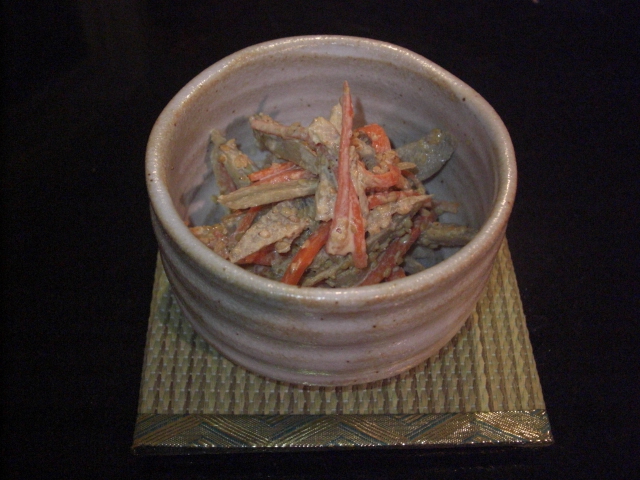
Gobo Salad (mayo)

http://www.japanfoodaddict.com/vegetables/gobo-salad/

Gobo is known as burdock root in English. It is a fibrous vegetable seldom used in North America and Australia, but you can find it at most Asian groceries. This salad is popular way to eat gobo. Many izakaya restaurants serve this salad as an appetizer in Japan and you can also buy it at supermarkets or delis. 
Yield: 2 people
Time: 15 minutes
Ingredients
  • 1/4 lb gobo
  • 1/2 carrot (1/5lb)
Spices
  • 3 tbsp Japanese mayonnaise, such as Kewpie
  • 2 tbsp ground white sesame
  • 1 tsp vinegar
  • 2 tsp soy sauce
  • 1 tsp sugar
Preparation
  1. Wash gobo with water and remove the skin with a carrot peeler or the edge of a knife. Repeat with carrot.
  2. Shred gobo and carrot into thin strips.
  3. Put the gobo in a sauce pan with enough water to cover the gobo. Bring to a boil.
  4. When it is boiling, keep it on for one minutes.
  5. Then add carrot and boil for another minute.
  6. Strain gobo and carrot then cool.
  7. Mix all spices in a small bowl (mayonnaise, sesame, vinegar, soy sauce and sugar.
  8. Mix gobo and carrot with mixed sauce, and serve.

Saturday, October 6, 2012

Tortillas

Thank you, mom, for finding this recipe.

Chewy Flour Tortillas

These tortillas have real body and taste; they are perfect for gorditas, fajitas and eating out of hand.
  • 2 cups all-purpose flour
  • 1-1/2 teaspoons baking powder
  • 1 teaspoon salt
  • 2 teaspoons vegetable oil
  • 3/4 cup lukewarm milk (2% is fine)
Stir together the flour and baking powder in a large mixing bowl. Add the salt and vegetable oil to the lukewarm milk and whisk briefly to incorporate. Gradually add the milk to the flour, and work the mixture into a dough. It will be sticky. Turn the dough out onto a surface dusted with flour and knead vigorously for about 2 minutes (fold and press, fold and press). The kneading will take care of the stickiness. Return the dough to the bowl, cover it with a damp cloth, and let it rest for 15 minutes. (This dough will not rise, but it needs a rest.)
Divide your dough into 8 balls of equal size, cover them, and let them rest again for about 20 minutes. Avoid letting them touch, if you don't want them to stick together.
Dust your work surface with flour. Working one at a time, remove each piece of dough and pat it into a 5-inch circle. With a rolling pin, roll out the tortilla, working from the center out, until you have a 7- or 8-inch tortilla a little less than 1/4 inch thick. Transfer the tortilla to a hot, dry skillet or griddle. It will begin to blister. Let it cook for 30 seconds, turn it, and let the other side cook for 30 seconds. Remove the tortilla, place it in a napkin-lined basket and cover with aluminum foil. Repeat for the remaining tortillas.
Although flour tortillas, like corn tortillas, are best if eaten right after they are made, these tortillas will freeze well. Wrap them tightly in plastic, and they will keep, frozen, for several weeks. To serve tortillas that have been frozen, let them thaw and come to room temperature, then wrap them in aluminum foil and heat them in a warm oven. Microwaving tends to toughen them.

Homemade Flour Tortilla Tips

Rolling out tortillas in perfect circles is harder than it sounds.
  • Do not use bread flour. You want flour with a low gluten content.
  • You don't want to over-flour your work surface, but you don't want your rolled-out tortilla sticking to it either. I found that the dough adhered less to an unvarnished wood surface (like an old cutting board) than any other surface I tried.
  • A flat dough scraper, known in baking parlance as a bench knife, is very efficient in removing the rolled-out tortilla from the work surface.
  • When rolling out tortillas, dust your rolling pin with flour, and don't be afraid to apply pressure. Flour tortilla dough is pretty sturdy; but not to the point of rerolling. You don't want tough tortillas.
  • The Border Cookbook recommends the use of a tortilla roller (similar to a short piece of broomstick), rather than a rolling pin.
  • Rolling out tortillas in perfect circles is harder than it sounds; the dough wants to draw up. So if perfectly circular shapes are important, you can trim away the excess with a sharp knife.
  • Once again, I believe a cast iron skillet or griddle is practically indispensable for making any kind of tortilla. A dry cast-iron utensil, unlike most other materials, can take high temperatures over a sustained period of time without being adversely affected, although you may have to do a reseasoning afterwards (see How to Love Your Cast-Iron Skillet).
Once you get a rhythm going, you can roll out a tortilla, put it on to cook and, while it cooks, roll out your next tortilla. Seems like an arduous process but, with this method, I could produce 8 tortillas in about 10 action-packed minutes. Be sure to rewrap your fresh tortillas each time you add another to the stack. If you like, you can substitute one cup of whole wheat flour for one cup of the all-purpose flour. Prep time: 40 minutes; Cooking time: 1 minute; Total time: 41 minutes
My personal preference is for plain tortillas but if desired, you can spice up this recipe by adding:
  • A tablespoon of chopped fresh herbs (like oregano or rosemary)
  • A teaspoon or so of dried herbs
  • Freshly ground black pepper
  • A tablespoon of minced jalapeños
  • A little garlic powder (or substitute garlic salt for the salt)
If you choose to experiment with seasonings, mix dry spices with the flour mixture and fresh or "wet" seasonings with the milk. My results with the above recipe were outstanding -- chewy, delicious, irresistible. My experience with the Sonoran variety, however, was less than spectacular.

http://www.texascooking.com/features/sept98flourtortillas.htm

Tuesday, August 7, 2012

Sushi

Thanks, Daniel!

You need Sushi Rice not long grain rice.

2 Cups Water and 2 Cups Sushi (aka short-grained rice). Put in a medium sized pot and bring to a boil. Cover and turn down the heat to low and let simmer for 20 minutes (till all the liquid is absorbed). Turn off the heat and let sit covered till you are ready to do the next part.
While the rice is cooking,
combine in a bowl (for the microwave) or a small pot on the stove.
1/4 Cup Rice vinegar
1 Tablespoon of sugar
2 teaspoons of salt
The point here is to dissolve the sugar and salt, so just heat it and stir it till that happens...just a couple of minutes.

Pour the rice from the pot into a wooden or ceramic bowl and stir it with a lifting motion. Adding a little of the vinegar mixture at a time. You want to combine it into the rice and cool it  which makes it glossy.  If you can use a fan in one hand while stirring  or recruit a  friend  or  have an  electric fan  that helps.  If the rice gets sticky on the  spoon/spatula  rinse it in cold water like you do to the sushi  knife  to  "de-goo-ify"  it.


When it comes to actually rolling the sushi, do the following:
-lay out a sheet of nori.
-Place a large glob of sushi rice onto the nori.
-Use the back side of a spoon (Dipped in water to help keep the rice from sticking) to spread an even layer of rice over most of the sheet of nori. Leave about an inch strip along one edge clear of rice.
-Place a strip of whatever ingrideants you want running parallel to the bare strip of nori, but on the far edge.
-Use your finger to wet the bare strip of nori, and then roll up the nori form the ingrediant side. The wet edge of nori should adhere to the rest of the roll and keep it from unraveling.
-cut to desired thickness.

Mint Liquor-- mixed results.

I threw in about three cups of mint, 1 cup of rock sugar, and 2 cups of white liquor into a jar and let it sit for three days. The resulting drink has a pleasing mint flavor, but is brown.

Next test: rub mint in sugar, use fine sugar so it dissolves faster, and leave mint in for less than a day. That might help preserve the pretty green color. Or, if using for a party, just always plan to make it the day beforehand.

Egg Vegetable Dish on Rice (Maybe Donburi?)

Basic Ingredients:
-onion
-green vegetable (spinach, kale, cabbage)
-eggs
-oil
-soy sauce
-rice

Other optional Ingredients:
-carrot
-soft potatoes (the red-skin potatoes, or the soft yellow ones I think of as "butter potatoes" but I really don't know what they're really called. NOT the big brown dirty hard baking potatoes.)
-bell pepper, any color
-garlic
-ginger
-mushroom
-zucchini
-bits of tofu would probably be tasty, but I've never tried.

  1. Get the rice cooking.
  2. Cut your onions into small slices (or dice them, depending how you want the texture). Heat a pan with oil, and start the onions cooking on low to medium heat.
  3. While the onions are cooking, chop carrots. Fine rounds, or half moons, or quarters are fine, or dicing them. Again, depends on texture. Put in with carrots, and stir around. Add a few tablespoons of soy sauce (the water on the bottom of the pan will help keep it from burning while you cook other things). Adding a lid helps things cook longer.
  4. If you want to add ginger, mince or grate it and add it now, so the flavors have time to diffuse. Also, if you want garlic, add it now. I have never done both garlic and ginger at the same time, but, who knows, it may be tasty!
  5. Add any medium-hardness vegetables (not hard like carrots or potatoes, but not soft like a leaf. Bell peppers, mushrooms. Now's also a good time to add the stems of the leafy vegetables, or  very small chopped cabbage, if you want).
  6. Crack a few eggs into a bowl and mix with a fork/whisk.
  7. When the onions look clear and the potatoes/carrots are getting soft and edible, put in the soft leafy vegetables. Dark green soft-leaved vegetables, like spinach, bok choy, or komatsuna, can be chopped coarsely.
  8. After you put in the greens, turn the whole mess over a few times with a spoon to get the greens started and make sure everything else is cooked, and then pour eggs over. I whisk while I pour so the eggs drizzle out instead of sliding out with a big plop, and I can cover more of the vegetables more finely.
  9. I turn the mess over once, and then turn the heat off before all the eggs cook-- the heat of the vegetables will cook most of the raw bits of egg. If you are in America and are more worried about salmonela, cook until the eggs are all firm.
  10. Serve over rice! Yum!

Baked Vegetable Soup

Kale and Roasted Vegetable SoupServes 4
3 medium carrots, cut into 1/2-inch slices
2 tomatoes, cut into wedges (or 1 15-ounce can of no added salt tomatoes)
1 yellow onion, peeled and cut into 6 to 8 wedges
6 big cloves of garlic, peeled
1/2 butternut squash, peeled and cut into cubes (you can also use eggplant)
1 bunch of kale, stacked, rolled up, then thinly sliced
1 can cannellini beans, drained, or 1 1/2 cups freshly cooked white beans
6 cups vegetable stock
1 heaping teaspoon dried thyme or a palm-full of fresh thyme sprigs
1 bay leaf
salt and freshly ground pepper to taste
  • Preheat oven to 400 degrees.
  • Lightly oil a rimmed baking pan. Arrange the carrots and squash (or eggplant) on one end and the onions, garlic, and tomato on the other. Roast until everything is slightly browned, around 30 minutes.
  • Scoop the onions, tomatoes, and garlic into a blender. Puree the vegetables briefly. Add the stock and mix briefly.
  • Bring the stock with blended veggies to a simmer. Add the kale, thyme, and bay leaf. Cook until the kale is tender, about 30 minutes.
  • Add the carrots, squash (eggplant), and white beans. Cook for about 5 more minutes. Remove the bay leaf and the thyme sprigs if you used fresh thyme.
  • Season to taste and serve hot.
Nutrition information per serving:
Calories: 271
Fat: 4 g
Saturated Fat: 1 g
Trans Fat: 0 g
Cholesterol: 0 mg
Carbohydrate: 49 g
Fiber: 11 g
Sugars: 7 g
Sodium: 192 mg (without added salt)
Protein: 19 g